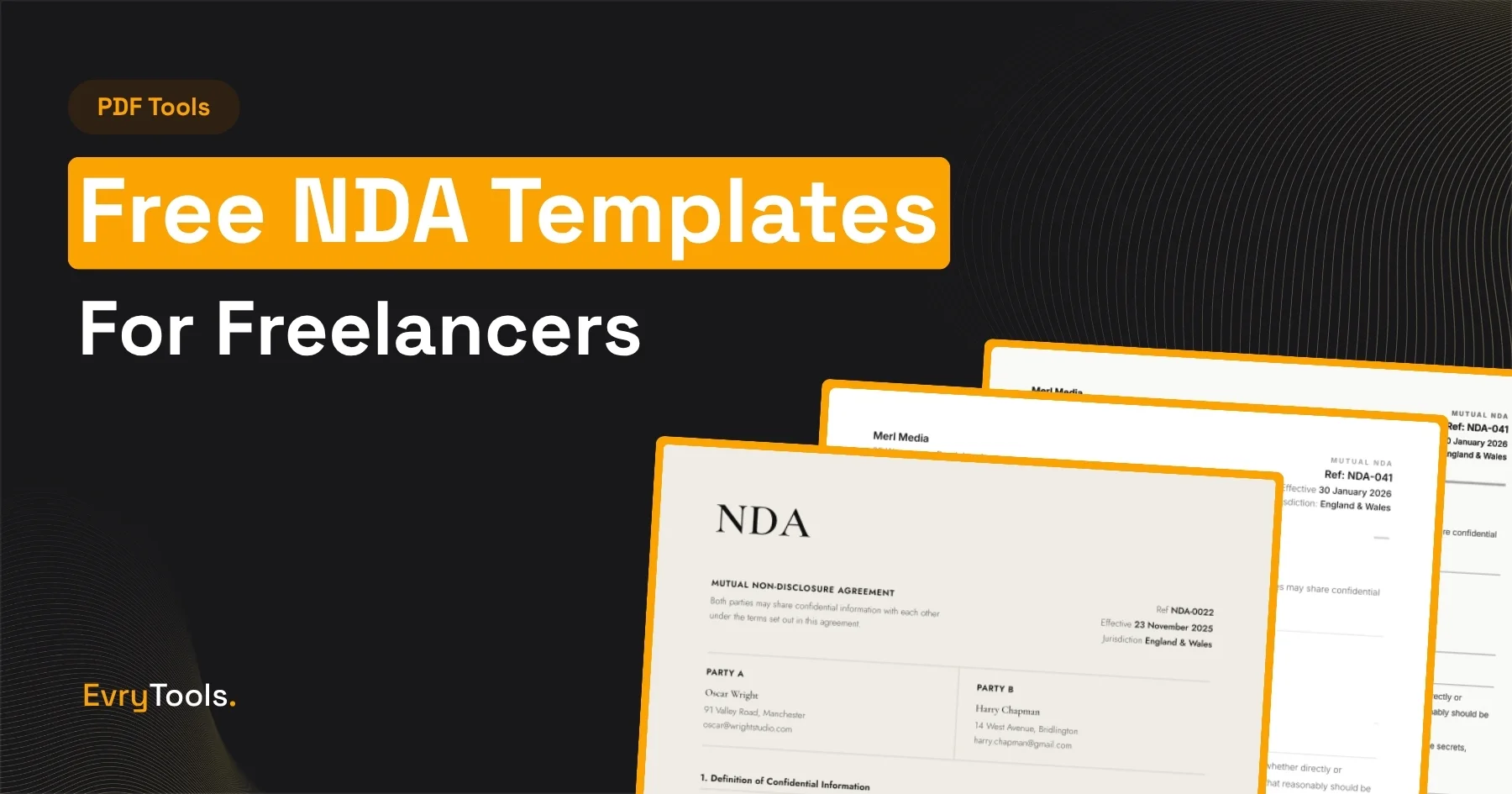
As a freelancer, you’ll encounter two NDA situations repeatedly: a client asks you to sign one before sharing their confidential brief, and you need one before sharing your own confidential work or ideas with someone else. Both are straightforward with the right tool. The EvryTools NDA Generator creates a professional NDA in minutes — free, no signup, and nothing stored on any server.
The Two NDA Situations Freelancers Actually Face
Most NDA guides are written from a corporate perspective — merger discussions, investor due diligence, enterprise software deals. Freelancers encounter NDAs in more specific, everyday situations.
Situation 1: A Client Asks You to Sign Their NDA
This is the most common scenario. Before sharing a brief, background materials, or any confidential information about their business, the client sends you an NDA to sign. They want assurance you won’t share their strategy, unreleased products, client list, or internal processes with anyone else.
In this situation, you’re the receiving party. You’re agreeing to keep their information confidential for a defined period. Before signing, check:
- What’s defined as confidential — make sure the definition isn’t so broad it covers information you already knew or that’s publicly available
- The duration — two to three years is standard; perpetual NDAs are unusual for standard freelance work
- The scope of permitted use — you should be able to use the information only for the purpose of this specific project
- Whether it prevents you from working with competitors — some NDAs include non-compete provisions. These are separate from confidentiality obligations and you’re entitled to push back on them
Most client NDAs are standard documents. If anything looks unusual, it’s reasonable to ask for clarification before signing.
Situation 2: You Need to Protect Your Own Information
You may be the disclosing party when:
- You’re sharing a business idea with a potential co-founder or business partner
- You’re pitching a creative concept to a client before a contract is signed
- You’re briefing a subcontractor on a client’s project (check whether your client’s NDA permits this first)
- You’re bringing in a collaborator who will have access to sensitive information
In this situation, the other party signs the NDA and agrees to keep your information confidential. You’re using the NDA to protect yourself.
When a Freelancer Actually Needs an NDA
Advertisement
Not every client conversation needs an NDA. Being overly formal about confidentiality for routine work can feel bureaucratic to clients and may signal inexperience rather than professionalism.
An NDA is appropriate when:
- A client is sharing genuinely sensitive business information before work begins — unreleased products, pricing strategy, internal data, customer records
- You’re having speculative or exploratory conversations about a business idea or concept
- You’re working with proprietary technology or trade secrets
- The client specifically requests one (always a reasonable request to accommodate)
An NDA is less necessary when:
- The work is purely executional with no sensitive information involved — building a website to a standard brief, writing blog posts on public topics
- The information shared is not confidential in nature
- The engagement is short, well-defined, and low-stakes
When in doubt, having an NDA available is better than not having one. It takes five minutes to generate and costs nothing.
One-Way vs Mutual NDA: Which Do You Need?
The most important decision when creating an NDA is whether it should be one-way or mutual.
A one-way (unilateral) NDA protects the disclosing party. Only the receiving party is bound by confidentiality obligations. Use this when information flows in one direction — typically when a client is sharing their confidential information with you, or when you’re sharing something with a contractor or collaborator.
A mutual NDA protects both parties equally. Both sign and both agree to keep the other’s information confidential. Use this when information flows both ways — when you and a potential co-founder will both share sensitive information with each other, or when a client engagement involves confidential information on both sides.
For most standard freelance work, a one-way NDA (in favour of the client) is what’s needed. For exploratory conversations where both parties are sharing sensitive ideas, a mutual NDA makes more sense.
What to Include in a Freelance NDA
Your Details and the Other Party’s Details
Full legal names or business names and addresses for both parties. If you operate under a trading name, use your full legal name as well. “Sarah Johnson trading as SJ Creative Studio” rather than just “SJ Creative Studio.”
Definition of Confidential Information
What counts as confidential under this agreement. A well-drafted definition covers:
- Specific categories relevant to the situation (business plans, financial projections, technical documentation, client lists, unreleased products)
- A general catch-all for information that would reasonably be understood to be confidential
- Information disclosed orally and confirmed in writing within a specified period
What’s Excluded
Information that’s not covered even if it meets the general definition:
- Information already public when the agreement is signed
- Information that becomes public through no fault of the receiving party
- Information the receiving party already knew before the agreement
- Information independently developed without using the confidential information
These exclusions protect the receiving party from unreasonable obligations.
Permitted Purpose
Why you’re receiving the information. Be specific: “for the purpose of evaluating a potential web development engagement for the client’s e-commerce platform” is better than “for business purposes.” The more specific the permitted purpose, the clearer the boundaries of what the information can be used for.
Obligations
What the receiving party agrees to do:
- Not disclose confidential information to anyone outside the agreement
- Use confidential information only for the permitted purpose
- Take reasonable measures to protect the information (the same measures used for their own confidential information)
- Limit access to people who need it for the permitted purpose
Duration
How long the confidentiality obligation lasts. One to three years is standard for most freelance NDAs. The duration should reflect how long the information is likely to remain sensitive — a client’s unreleased product becomes less sensitive after launch; long-term business strategy may warrant a longer period.
Governing Law
Which country or region’s law governs the agreement. For UK-based freelancers working with UK clients, this is straightforward. For international work, specify explicitly.
How to Create Your NDA With EvryTools
- Go to evrytools.com/tools/nda-generator
- Select One-Way or Mutual depending on your situation
- Enter your details as the disclosing or receiving party
- Enter the other party’s details
- Describe the confidential information specifically — “client’s business strategy, product roadmap, and unreleased marketing campaigns for Project X” is better than “all business information”
- Set the permitted purpose — what the information is being shared for
- Choose the agreement duration — typically one to three years
- Select your jurisdiction
- Choose a design style — Studio, Serif, or Clean
- Click Download PDF
100% private — your details, the client’s details, and the specifics of the agreement never leave your browser.
The design styles match the proposal generator, statement of work generator, and invoice generator — so all your client documents have a consistent visual identity.
Getting the NDA Signed
Advertisement
A downloaded PDF is a document. A signed PDF is an agreement. Always get both parties to sign before sharing any confidential information.
Practical signing options for freelancers:
Email with PDF annotation — both parties sign digitally in Adobe Reader or Apple Preview. Legally valid but less formal.
DocuSign free tier — handles up to three documents per month. For occasional NDAs, this covers most freelancers without a paid plan. The audit trail DocuSign creates is useful if a signature is ever questioned.
HelloSign free tier — similar to DocuSign. Three documents per month on the free plan.
Print and scan — still fully valid. Works well when one party prefers physical signatures.
The signed copy should be stored somewhere you can find it without difficulty if a question arises months or years later. A dedicated folder in cloud storage, labelled clearly with the client name and date, is sufficient.
When a Lawyer Is Worth It
The EvryTools NDA generator produces a well-structured standard NDA appropriate for most freelance situations. Some situations genuinely warrant legal advice:
- The engagement involves significant financial value or high-stakes IP
- The client’s NDA includes provisions you don’t fully understand
- You’re entering a partnership or co-founder relationship
- The work involves regulated industries — financial services, healthcare, legal — where confidentiality obligations have additional legal dimensions
- You’re working across jurisdictions where contract law differs significantly
A one-hour consultation with a contracts solicitor or attorney typically costs £150-300 in the UK or $150-400 in the US. For high-value engagements, that’s a worthwhile investment. For standard freelance project work, a well-written standard NDA handles everything you need.
Final Thoughts
NDAs are a routine part of professional freelance work. Having a well-designed one ready to generate and send in minutes — rather than searching for templates, editing Word documents, or paying for a platform subscription — removes friction from a process that should be simple.
EvryTools NDA Generator creates a professional NDA in three design styles, for free, with no account required, and with nothing leaving your browser. The whole process from blank to signed PDF takes under ten minutes.
Frequently Asked Questions
Is a free NDA legally valid?
Yes, when properly executed. The legal validity of an NDA depends on whether it meets contract law requirements — offer, acceptance, consideration, and intent to be bound — not on whether it was drafted by a lawyer or generated by a tool. A well-structured standard NDA meets these requirements. For complex or high-value situations, legal review remains worthwhile.
Should I sign a client’s NDA without reading it?
No. Always read what you’re signing. Most client NDAs are standard documents with no surprises, but occasionally they contain provisions worth questioning — overly broad confidentiality definitions, non-compete clauses, or unusually long durations. Reading takes five minutes and could save a significant dispute later.
Can I use the same NDA template for every client?
The structure can be reused. The key sections — confidential information definition, permitted purpose, and duration — should reflect the specifics of each situation. A generic NDA with the names swapped in is technically valid but may not accurately reflect the actual scope of what’s being protected.
Does signing an NDA mean I can’t mention the client in my portfolio?
Not automatically. An NDA restricts disclosure of specified confidential information. Mentioning that you worked with a client, describing the general nature of the project, and including work samples in your portfolio is usually permitted unless the NDA specifically restricts it. Check the confidential information definition and the permitted use clause if you’re unsure. Some clients add a specific clause about portfolio use — this is negotiable.
What if someone breaches the NDA?
Document the breach clearly — what was disclosed, to whom, and when. Contact a solicitor or attorney for advice on your options. NDAs are enforceable contracts and breach can entitle the disclosing party to damages or injunctive relief (a court order preventing further disclosure). The stronger and more specific your NDA, the clearer your position in any dispute.