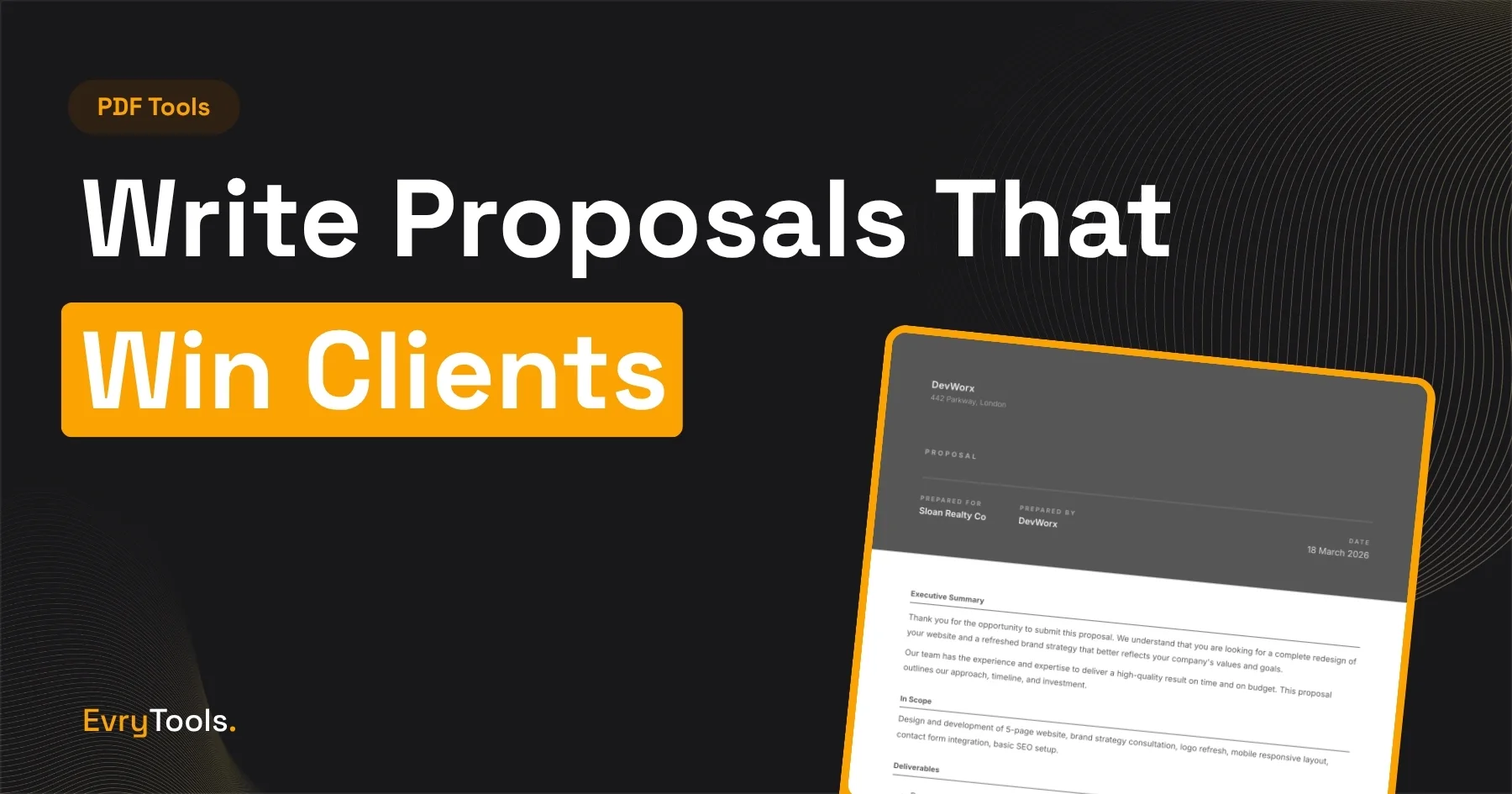
A project proposal is the document that turns an interested prospect into a paying client. Most freelancers and consultants underestimate how much the structure and presentation of a proposal affects the outcome — not just whether they win the work, but at what rate. This post covers what to include, what to leave out, and how to produce a professional proposal quickly using the EvryTools Proposal Generator — free, no signup, and ready to download as a PDF.
What a Project Proposal Actually Is
Advertisement
A proposal is not a quote. A quote is a price. A proposal is a document that demonstrates you understand the client’s problem and explains specifically how you’ll solve it — with the price as a consequence of that solution, not the centrepiece.
This distinction matters because clients who receive a well-structured proposal don’t evaluate it the same way they evaluate a quote. A quote triggers price comparison. A proposal triggers confidence assessment. The question shifts from “is this the cheapest?” to “is this the right person?”
A good proposal also protects you. By defining scope, deliverables, and assumptions clearly in writing before work begins, you create a shared reference point that reduces scope creep and dispute risk.
What to Include in a Project Proposal
A proposal should be long enough to demonstrate understanding and short enough to be read. For most freelance engagements, five to seven sections covers everything needed.
1. Executive Summary
One to three short paragraphs at the top. Not an introduction to you — an introduction to the client’s situation as you understand it. Summarise the problem or opportunity they’re facing, what the outcome of this project will be, and why you’re the right person to deliver it.
Most clients read the executive summary and the price, then skim everything else if the first two look right. This section carries disproportionate weight.
Write it last. It’s easier to summarise the proposal once the rest exists.
2. About You / Your Approach
One to two paragraphs maximum. Brief relevant background, the specific experience that applies to this project, and your working methodology where relevant. This is not a biography — it’s a targeted credibility statement.
Avoid: “I am a passionate and driven professional with over X years of experience.” Lead with something specific to this client’s project instead.
3. Proposed Scope and Deliverables
The most important technical section. Define exactly what is included in the engagement:
- What you will deliver
- What format those deliverables take
- What is explicitly out of scope (just as important as what’s in)
- Any assumptions the proposal is based on
Be specific. “Website redesign” is not a deliverable. “Redesign of five core pages (Home, About, Services, Contact, Blog) to be delivered as Figma files and live code in the agreed tech stack” is a deliverable.
Vague scope documents produce scope disputes. Specific scope documents protect both parties.
4. Timeline and Milestones
A realistic project timeline broken into phases or milestones. Include:
- Project start date (or the date from which timing runs)
- Key milestones with expected completion dates
- Any dependencies on client input or approvals that affect the schedule
- Final delivery date
If the project timeline depends on prompt feedback or content supply from the client, say so explicitly. “Phase 2 begins within five business days of receiving client sign-off on Phase 1 deliverables” is a sentence that prevents a lot of future frustration.
5. Investment
The price section. Present it clearly:
- A total project fee or a rate with estimated hours
- What payment structure you require — typically 50% upfront, 50% on completion for project work, or monthly for retainers
- What payment methods you accept
- Whether the quote includes revisions and if so, how many rounds
If you’re offering tiered options — a core scope and an expanded scope at different price points — this is where to present them. Give clients a choice between two options, not an open question. “Would you like to add X for £Y additional?” is more effective than a single figure with no context.
6. Terms and Next Steps
A brief section covering:
- How long the proposal is valid (two to four weeks is standard)
- What happens next — typically “sign and return this proposal” or “reply to confirm”
- A reference to the full terms or statement of work that will govern the engagement
Keep this short. The purpose is to make accepting the proposal as frictionless as possible.
7. Optional: Case Study or Relevant Work Sample
For higher-value engagements, one relevant case study or portfolio reference adds confidence. Keep it to a single example that’s directly relevant to this specific project — not a portfolio dump.
Common Proposal Mistakes
Leading with your background instead of their problem. Clients care about their project first. Demonstrate understanding before credentials.
Pricing before scope. Some freelancers send a figure before fully scoping the work. This trains clients to anchor on price rather than value. Scope first, then price as the natural output.
Being vague about deliverables. The more specific your scope, the more professional you appear — and the better protected you are if the client’s expectations turn out to be wider than yours.
Using the same template unchanged for every client. The executive summary in particular should reference this client’s specific situation, not generic placeholder text.
Not stating a validity period. A proposal with no expiry can be accepted six months later when your rates have changed or your availability has shifted. Always include “this proposal is valid for 30 days from the date of issue” or similar.
How to Use the EvryTools Proposal Generator
The EvryTools Proposal Generator produces a professional proposal PDF in three design styles — Studio, Serif, and Clean — with all the sections above pre-structured and ready to fill in.
- Go to evrytools.com/tools/proposal-generator
- Choose your design style — Studio for creative industries, Serif for professional services, Clean for any context
- Fill in your business details, the client’s details, and the project name
- Complete each section — executive summary, scope, timeline, investment, and terms
- Add your logo if you have one
- Click Download PDF
The PDF is ready to send as an email attachment or share via a link. No account required, no EvryTools branding in the document, and nothing stored on any server. 100% private — your proposal content never leaves your browser.
The design styles match the invoice generator, NDA generator, and statement of work generator — so every document a client receives from you has a consistent visual identity.
After the Proposal: What Comes Next
Advertisement
A proposal is not a contract. Once a client accepts your proposal, the engagement should be confirmed with a statement of work or service agreement that formally defines the scope, deliverables, and payment terms.
The EvryTools Statement of Work Generator handles this in the same three design styles, giving you a complete document pair — proposal followed by SOW — that covers both the selling stage and the contractual stage of the engagement.
For projects involving confidential information, an NDA signed before the proposal stage protects both parties during preliminary discussions. The EvryTools NDA Generator generates mutual or one-way NDAs in the same visual style.
Final Thoughts
A well-structured proposal is one of the highest-leverage documents a freelancer produces. It sets the tone for the entire client relationship, defines expectations before work begins, and directly affects both win rate and project value.
EvryTools Proposal Generator gives you a professionally designed template that covers every section — free, no signup, and downloadable as a PDF in minutes. The writing is yours; the structure and design are taken care of.
Frequently Asked Questions
How long should a freelance project proposal be?
Long enough to demonstrate clear understanding of the project and short enough to be read in full. For most freelance engagements, two to four pages is appropriate. Longer proposals are justified for complex, high-value projects. A one-page proposal is sometimes right for simple, well-defined work. Never pad length — a concise, specific proposal is always stronger than a lengthy vague one.
Should I send a proposal before or after a discovery call?
After. A proposal written without a conversation is a template, not a proposal. The discovery call is where you understand the client’s real situation, constraints, timeline, and definition of success — the information that makes the executive summary specific rather than generic. Proposals sent before a call rarely win work.
Is the EvryTools Proposal Generator really free?
Yes, completely free with no signup and no account required. There is no paid tier and no EvryTools branding in the downloaded document.
What’s the difference between a proposal and a statement of work?
A proposal is a sales document — it persuades the client to hire you. A statement of work is a contractual document — it formally defines what will be delivered, when, and under what terms. Most freelancers use both: a proposal to win the work, and an SOW to confirm it before work begins.
Can I use the same proposal template for every client?
The structure can be reused. The content — particularly the executive summary and the scope section — should be written specifically for each client. The quickest way to lose a proposal is to send one where the client can tell it’s a generic template with their name swapped in.